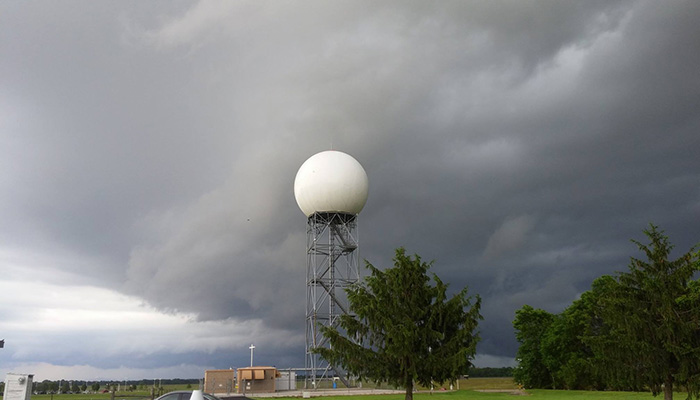
Have you ever wondered how meteorologists predict tomorrow's weather with such accuracy? The process behind weather forecasting combines cutting-edge technology, complex mathematical models, and human expertise to transform atmospheric data into reliable predictions. From Doppler radar scanning storm systems to satellites monitoring global weather patterns, modern forecasting represents one of science's most remarkable achievements.
The Science Behind Weather Prediction: How Forecasts Are Made
Weather forecasting follows a systematic three-stage process that transforms raw environmental data into the forecasts we rely on daily. According to the National Weather Service, meteorologists first gather comprehensive observations using radar, satellite imagery, and ground-based instruments to create a complete picture of current conditions. This data is then analyzed through numerical weather prediction models—sophisticated computer programs that solve mathematical equations representing atmospheric physics. Finally, human forecasters interpret these model outputs, applying their expertise to refine predictions and communicate uncertainty to the public.
This process happens continuously at weather centers worldwide, with forecasts updated multiple times daily as new data arrives. The chaotic nature of Earth's atmosphere means predictions become less certain further into the future, which is why tomorrow's forecast is typically more reliable than next week's outlook. Despite this inherent uncertainty, technological advances have dramatically improved forecast accuracy over recent decades.
The Human Element: Why Meteorologists Still Matter in the Digital Age
Despite advanced technology, human forecasters remain essential to the prediction process. Computers excel at processing vast amounts of data and solving complex equations, but they struggle with interpreting local effects, recognizing pattern anomalies, and communicating forecast uncertainty. Experienced meteorologists bring contextual knowledge that models lack—understanding how terrain influences weather, recognizing when instruments might be malfunctioning, and knowing historical weather patterns for their region.
At Weather Forecast Offices nationwide, meteorologists monitor multiple model outputs, comparing predictions and identifying which perform best for current conditions. They adjust computer-generated forecasts based on local knowledge, create severe weather warnings, and craft public messages that convey both the most likely scenario and potential worst-case outcomes. This human-machine partnership represents the future of forecasting, where technology handles data processing while experts focus on interpretation and communication.
The Future of Weather Forecasting: AI and Improved Models
Emerging technologies promise to further revolutionize weather prediction in coming years. Artificial intelligence and machine learning algorithms are being trained on historical weather data to identify patterns that traditional models might miss. These AI systems can process satellite imagery to detect developing storms earlier and predict their intensification more accurately. Additionally, next-generation satellites with higher-resolution sensors will provide even more detailed atmospheric measurements.
Computing advances will enable higher-resolution global models that can simulate smaller-scale weather features, while ensemble forecasting—running multiple model variations simultaneously—will better quantify prediction uncertainty. Researchers are also working on extending accurate forecast windows, with goals of making two-week forecasts as reliable as current five-day predictions. These improvements will enhance everything from daily planning to emergency preparedness for extreme weather events.
Key Takeaways: What to Remember About Weather Predictions
Understanding how weather forecasts work can help you interpret tomorrow's prediction more effectively. First, recognize that forecasts represent probabilities rather than certainties—meteorologists communicate likelihoods based on available data. Second, short-term predictions (1-3 days) are highly reliable, while longer-range forecasts involve more uncertainty. Third, different weather apps and services may show varying predictions because they use different data sources or interpretation methods.
Finally, remember that weather forecasting represents one of science's great success stories—a field where technological innovation has dramatically improved prediction capabilities within a single generation. The next time you check tomorrow's forecast, you'll appreciate the complex interplay of satellites, radar, supercomputers, and human expertise that makes that simple percentage chance of rain possible.