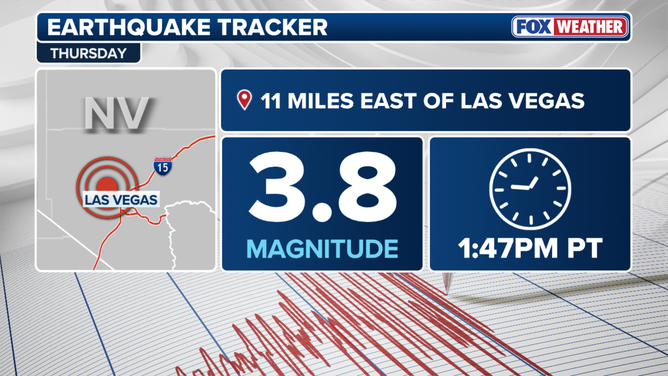
A magnitude 3.8 earthquake struck just outside Las Vegas on Thursday, June 4, 2026, shaking residents across the valley and serving as a powerful reminder that Nevada is earthquake country. The tremor, which hit at approximately 1:47 p.m. local time near the Summerlin area and Red Rock Canyon, was felt by thousands and prompted renewed questions about what actually causes the ground to shake beneath our feet.
Inside the Las Vegas Earthquake: What Happened
The earthquake, initially recorded as magnitude 4.1 before being revised to 3.8, occurred at a shallow depth of approximately 7 kilometers (4.3 miles) beneath the Earth's surface, according to the U.S. Geological Survey (USGS). The epicenter was located roughly 11 miles west of Las Vegas in the Red Rock Canyon area, and the USGS received more than 2,500 reports from individuals who said they felt shaking.
Clark County officials confirmed there was no damage to roads, pipelines, buildings or infrastructure. "It reminds us that Nevada is earthquake country," said Christie Rowe, director of the Nevada Seismological Laboratory. "We've always got to be ready for something bigger." Residents described the sensation as "a train coming through the house," according to social media reports.
How Earthquakes Happen: The Science Explained
An earthquake is what happens when two blocks of the Earth suddenly slip past one another along a fault. The surface where they slip is called the fault or fault plane, and the location below the Earth's surface where the earthquake starts is called the hypocenter or focus. The point directly above it on the surface is called the epicenter.
The Earth's outer layer, or crust, is made up of enormous tectonic plates that fit together like a jigsaw puzzle. These plates are constantly moving—very slowly—driven by heat from the planet's core. As the plates move, they scrape, bump, and drag against each other at their boundaries. Over time, stress builds up along fault lines where the plates meet. When the stress exceeds the strength of the rock, the rock suddenly breaks or slips, releasing stored energy in the form of seismic waves that radiate outward in all directions—much like ripples spreading across a pond after a stone is thrown in.
According to the USGS, most earthquakes are associated with tectonic plate boundaries, though they can also occur within plates due to internal stresses. The energy released travels through the Earth in different types of waves: P-waves (primary/pressure waves) that arrive first and feel like a sudden jolt, and S-waves (secondary/shear waves) that arrive next and produce the rolling, shaking motion most people associate with earthquakes.
Why Nevada Experiences So Many Earthquakes
Nevada is the third most seismically active state in the continental United States, behind only California and Alaska. Tens of thousands of microearthquakes occur in Nevada every year, along with occasional larger, mountain-forming earthquakes. Unlike California, which sits along the massive San Andreas Fault, Nevada's earthquake activity stems from a different geological process.
Las Vegas and the surrounding region lie within the Basin and Range Province, a vast geologic region where the Earth's crust is being gradually stretched and pulled apart. This stretching creates numerous active normal faults—fractures where one side of rock drops relative to the other—and strike-slip faults, producing the state's characteristic pattern of parallel mountain ranges and valleys. Nearly every mountain range in Nevada is bounded by one or more active faults, creating a broad network of seismic hazards rather than a single dominant fault line.
The Walker Lane, a highly active system of faults running approximately 600 miles along the Nevada-California border, is another significant source of seismic activity in the region. According to the Nevada Bureau of Mines and Geology, a hypothetical magnitude 7 earthquake near Las Vegas could cause approximately $21 billion in damage, tearing through vulnerable buildings and infrastructure. While Las Vegas doesn't match the extreme earthquake hazard of Los Angeles or San Francisco, it faces a moderate but very real seismic risk.
The Science of Earthquake Magnitude and Depth
The magnitude 3.8 earthquake measured by the USGS reflects the amount of energy released at the source. The magnitude scale is logarithmic, meaning a magnitude 4.0 earthquake releases about 32 times more energy than a magnitude 3.0, and a magnitude 5.0 releases about 1,000 times more energy than a 3.0. The depth of an earthquake is equally important: shallower earthquakes—like the approximately 7-kilometer depth of this Las Vegas event—tend to produce stronger shaking at the surface than deeper earthquakes of the same magnitude, because the seismic waves have less distance to travel and lose less energy along the way.
Aftershocks are common following earthquakes, even smaller events like a magnitude 3.8. These secondary quakes occur as stress adjusts along the fault line after the main rupture and can happen minutes, hours or even days later. Most aftershocks are weaker than the main quake, though seismologists monitor activity closely to track any unusual patterns. The most recent major earthquake in Nevada before this event was a magnitude 5.7 quake that struck near Silver Springs, about 45 miles east of Reno, on April 14, 2026.
The Basin and Range: Why the Ground Is Stretching
The Basin and Range Province, which covers most of Nevada, western Utah, and parts of surrounding states, is one of the most geologically fascinating regions in North America. Over millions of years, the Earth's crust here has been stretched by as much as 100%, creating a landscape of alternating mountain ranges and flat valleys. This stretching happens because the North American Plate is slowly spreading apart in this region, a process geologists call extension. As the crust thins and breaks, blocks of rock drop down along faults to form valleys, while adjacent blocks rise to form mountains. This ongoing process means new faults are constantly forming and old ones are being reactivated, keeping Nevada in a state of continuous seismic activity.
Where Things Stand Now: Latest on the Las Vegas Earthquake
Following the June 4 earthquake, officials confirmed there were no reports of injuries or structural damage. The Nevada Seismological Laboratory continues to monitor the area for aftershocks, though none of significance had been reported in the immediate aftermath. The earthquake was felt across the Las Vegas Valley, from Summerlin to Henderson, with some residents in neighboring states also reporting mild shaking.
This event follows a pattern of recent seismic activity in the region, including the magnitude 5.7 earthquake near Silver Springs in April 2026 and a series of 15 aftershocks that struck near the Area 51 military installation later that same month. While none of these events caused widespread damage, they collectively underscore the active seismic nature of the region.
What to Do During an Earthquake: Safety Tips for Las Vegas Residents
The City of Las Vegas recommends following the "Drop, Cover, and Hold On" protocol during any earthquake. If you are indoors, get under a sturdy desk or table, cover your head and neck, and hold on until the shaking stops. Contrary to popular belief, doorways are not necessarily the safest place—your best option is sturdy furniture that can protect you from falling debris. Do not run outside during the shaking, as you may be struck by falling glass, power lines, or building fragments.
If you are driving, pull over to a safe spot away from traffic, overpasses, and power lines, and stay in your vehicle with your seatbelt fastened until the shaking ends. If you are outside, move to an open area away from buildings, trees, streetlights, and utility wires, then drop, cover, and hold on. Emergency preparedness experts recommend having at least 10 days' worth of food and water on hand, as Las Vegas is an island in the desert with limited routes for aid to arrive if roads are damaged.
Key Takeaways: Understanding Earthquakes in the Silver State
- Earthquakes occur when tectonic plate movement builds stress along fault lines, causing rocks to suddenly break and release energy as seismic waves
- Nevada is the third most seismically active state in the continental U.S. due to its location in the Basin and Range Province, where the Earth's crust is being continuously stretched
- The June 4, 2026 magnitude 3.8 earthquake near Summerlin was shallow (about 7 km deep), which is why it was felt widely across the Las Vegas Valley
- Las Vegas faces a moderate seismic risk with multiple active faults crossing the region, though it lacks a single major fault like California's San Andreas
- No damage or injuries were reported from the June 4 earthquake, but experts warn that Nevada must always be prepared for a larger event
- If an earthquake strikes, remember: drop, cover, and hold on—stay indoors under sturdy furniture until the shaking stops