
For the first time since the Apollo 17 mission in 1972, NASA is preparing to send astronauts beyond low Earth orbit and toward the Moon. The Artemis II mission, scheduled to launch on April 1, 2026, at 6:24 p.m. Eastern Time, marks a historic return to lunar exploration and represents a critical stepping stone in NASA's ambitious Artemis program. This 10-day journey will carry four astronauts—three Americans and one Canadian—on a flight path that will take them around the Moon and back, testing key systems and operations needed for future crewed lunar landings.
How Artemis II Works: NASA's First Crewed Moon Mission in 50 Years
Artemis II is designed as a crewed test flight of NASA's Space Launch System (SLS) rocket and the Orion spacecraft. Unlike the uncrewed Artemis I mission that launched in 2022, Artemis II will carry astronauts to validate life-support systems, spacecraft performance, and mission procedures in deep space. The mission follows a free-return trajectory, meaning that after being propelled toward the Moon, the spacecraft will use lunar gravity to swing around the far side and return to Earth without requiring significant engine burns. This approach provides a safety margin for the crew while allowing engineers to gather critical data on how humans and equipment fare in the deep-space environment.
The launch window opens at 6:24 p.m. EDT on April 1, 2026, and extends for two hours. If weather or technical issues delay liftoff, backup opportunities exist through early April. Once launched, the SLS rocket's upper stage will propel the Orion spacecraft into a highly elliptical Earth orbit, where the crew will conduct system checks and prepare for the translunar injection burn that sends them toward the Moon.
Meet the Artemis II Crew: Pioneers of the New Lunar Era
The four astronauts selected for Artemis II represent a milestone in spaceflight diversity. NASA astronaut Reid Wiseman serves as mission commander, with Victor Glover as pilot. Mission specialists Christina Koch (NASA) and Jeremy Hansen (Canadian Space Agency) round out the crew. This mission will make Koch the first woman to travel to lunar distance, Glover the first person of color, and Hansen the first Canadian to venture beyond low Earth orbit.
All four crew members are seasoned spaceflight veterans. Wiseman previously spent six months aboard the International Space Station in 2014. Glover piloted the SpaceX Crew-1 mission to the ISS in 2020–2021. Koch holds the record for the longest single spaceflight by a woman (328 days) and participated in the first all-female spacewalk. Hansen, a former fighter pilot, brings extensive operational experience from the Canadian Space Agency. In the days before launch, the crew entered a standard quarantine period to minimize health risks and completed final simulations and briefings at Kennedy Space Center.
The 10-Day Journey: A Timeline of Artemis II's Mission
Artemis II follows a meticulously planned timeline that balances system checks, crew activities, and scientific observations. Here’s a day-by-day breakdown of the mission’s key phases:
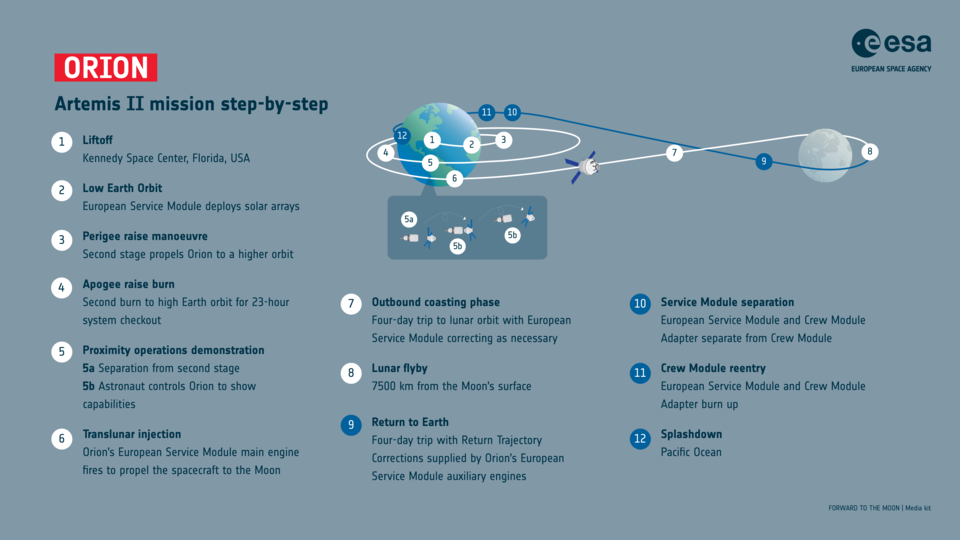
- Launch Day (Day 1): Liftoff from Kennedy Space Center’s Launch Complex 39B. The SLS rocket accelerates Orion to orbital velocity. After separation, Orion deploys solar arrays and begins systems verification.
- Earth Orbit Phase (Days 1–2): The crew conducts thorough checks of Orion’s navigation, communication, and life-support systems. They also perform a manual piloting demonstration to test the spacecraft’s handling.
- Translunar Injection (Day 2): Orion’s European Service Module engines fire to send the spacecraft on a path toward the Moon. This critical burn lasts approximately 20 minutes.
- Outbound Cruise (Days 3–4): The crew monitors spacecraft systems, conducts medical checks, and enjoys views of Earth receding behind them. They may also perform simple science experiments.
- Lunar Flyby (Day 5): Orion reaches its closest approach to the Moon, passing about 7,500 kilometers (4,700 miles) beyond the far side. The spacecraft uses lunar gravity to slingshot back toward Earth.
- Return Cruise (Days 6–8): Activities include system checks, crew rest, and preparation for reentry. The crew may conduct live video broadcasts to share their experience.
- Reentry and Splashdown (Day 10): Orion jettisons its service module and orients its heat shield for atmospheric reentry. Parachutes deploy to slow the capsule, leading to a splashdown in the Pacific Ocean off the coast of California.
The Technology Behind Artemis II: SLS Rocket and Orion Spacecraft
Artemis II relies on two flagship NASA systems: the Space Launch System (SLS) rocket and the Orion crew capsule. The SLS is the most powerful rocket ever built, standing 98 meters (322 feet) tall and capable of generating 8.8 million pounds of thrust at liftoff. Its core stage is powered by four RS-25 engines originally used on the Space Shuttle, flanked by two solid rocket boosters. The rocket’s upper stage, known as the Interim Cryogenic Propulsion Stage, provides the final push to send Orion toward the Moon.
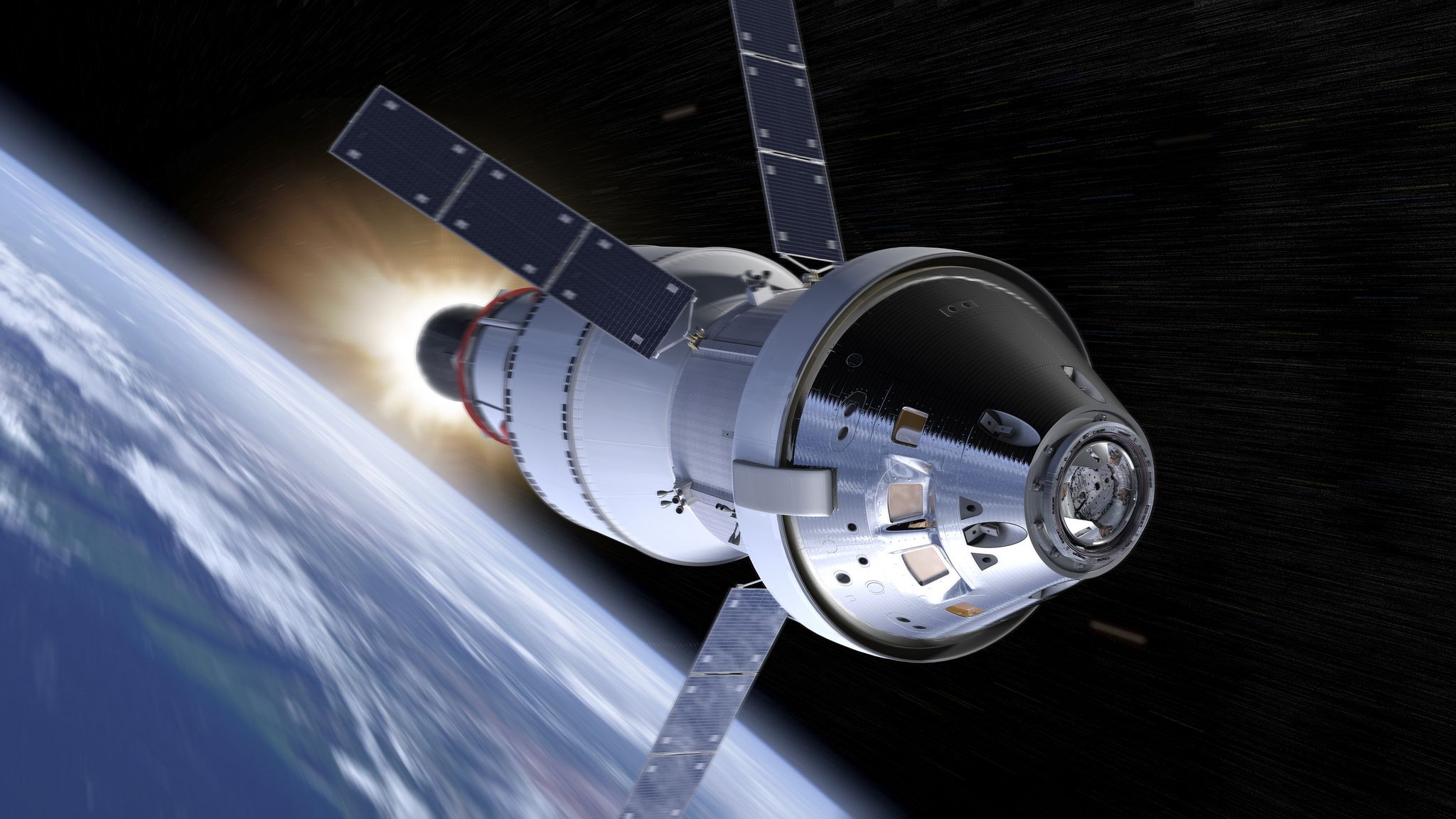
Orion is a state-of-the-art crew vehicle designed for deep-space missions. It consists of two main elements: the Crew Module, where astronauts live and work, and the European Service Module, built by the European Space Agency. The service module supplies power, propulsion, thermal control, and life-support resources. Orion’s advanced heat shield, the largest ever flown, protects the crew during high-speed reentry at about 40,000 km/h (25,000 mph).
Why Artemis II Matters: The Future of Lunar Exploration
Artemis II is more than a symbolic return to the Moon—it’s a necessary proving ground for the technologies and operations required for sustainable lunar exploration. The mission will test Orion’s life-support systems, radiation protection, and communication capabilities in the deep-space environment. It will also validate procedures for crew health monitoring, emergency responses, and mission control coordination during a lunar flight.
Successfully completing Artemis II will pave the way for Artemis III, currently planned for 2028, which aims to land astronauts near the lunar south pole. Subsequent Artemis missions will establish a lunar orbiting space station called Gateway and eventually a sustained human presence on the Moon. The data gathered from Artemis II will directly inform the design of future lunar landers, surface habitats, and exploration strategies.
What Happens Next: The Road to Artemis III and Beyond
Assuming Artemis II achieves its objectives, NASA will shift focus to Artemis III—the program’s first crewed lunar landing. That mission will involve a complex orbital rendezvous between Orion and a commercially developed human landing system, which will ferry two astronauts to the lunar surface. Meanwhile, international partners like ESA, Canada, Japan, and others are contributing modules, robotics, and infrastructure to the Gateway station, which will serve as a staging point for lunar sorties and deep-space missions.
The Artemis program represents a collaborative, sustainable approach to lunar exploration, with the ultimate goal of preparing for human missions to Mars. Artemis II is the crucial bridge between the early test flights and the operational phase of this ambitious endeavor. As Reid Wiseman, Artemis II commander, stated in a pre-launch briefing: “The four of us, we are ready to go. The team is ready to go. The vehicle is ready to go.”
With launch just hours away, the world watches as NASA embarks on a new chapter of human space exploration—one that promises to extend our reach farther into the solar system than ever before.