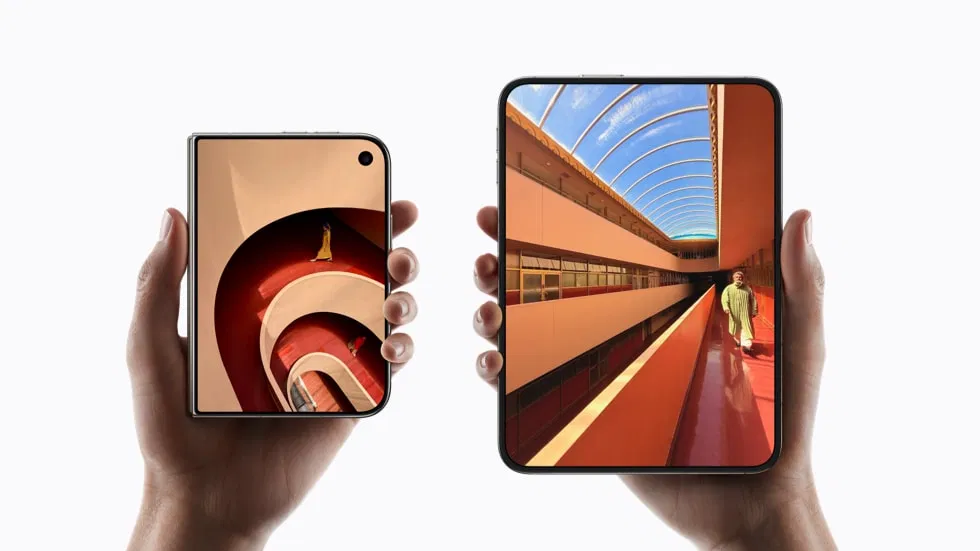
The iPhone Duo is Apple's first foldable smartphone — a book-style device that opens from a compact 5.4-inch outer screen into a 7.6-inch, tablet-like canvas. Unveiled on September 9, 2026, at Apple Park in Cupertino, California, and scheduled to launch on October 23, 2026, the iPhone Duo starts at $1,999. The announcement represents one of the most significant redesigns in iPhone history, pairing a titanium frame, a precision-engineered hinge, and the new A20 Pro chip with a version of iOS 27 built specifically for two screens. As the first foldable in Apple's lineup, it answers a long-running question among iPhone fans: what happens when the company finally enters the foldable market that Samsung and others have been shaping for years.
Apple Unveils Its First Foldable iPhone
Apple CEO John Ternus introduced the iPhone Duo during the company's "Surprise and Shine" event on September 9, 2026, alongside the iPhone 18 Pro and iPhone 18 Pro Max. It was Ternus's first major product showcase as chief executive, and he framed the device as a turning point for the iPhone. "iPhone Duo is the most transformational change to iPhone since the original," Ternus said. "With an entirely new design and intuitive experiences, it shows what's possible when hardware and software are engineered together and redefines what it means to use a foldable phone."
At its core, the iPhone Duo is a passport-shaped foldable that works like a normal smartphone when closed and expands into a larger workspace when opened. Apple says the device is the thinnest iPhone ever made when fully open, with its internal components packaged into what the company calls a "camera plateau." The frame is machined and polished grade 5 titanium, and the device carries an IP68 dust and water resistance rating, meaning it can survive submersion in up to six meters of water for 30 minutes.
How the Foldable Design Works
The iPhone Duo's defining feature is its pair of displays, both built around the same aspect ratio so content transitions smoothly between them. The 5.4-inch outer Super Retina XDR screen offers roughly 90 percent of the screen area of the iPhone 18 Pro, making the phone comfortable to use one-handed when folded. Opening the device reveals a 7.6-inch inner display that is about 50 percent larger than the iPhone 18 Pro Max — the largest display ever shipped on an iPhone.
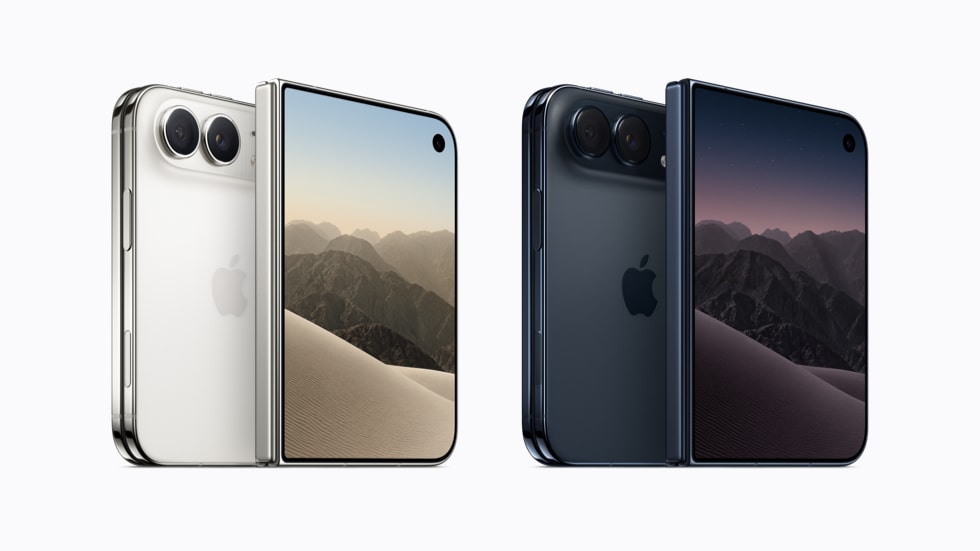
The hinge is one of the most talked-about pieces of the hardware. It is built from more than 100 precision components and uses a multi-layer lamination design with viscoelastic adhesives that let the display's layers glide past one another "like pages in a book" during folding. A titanium plate forms the bottom layer for durability, while carbon fiber support plates keep the base stiff and lightweight. Apple also developed a custom nano-texture finish for the inner screen that reduces glare and minimizes the visibility of the fold crease. Touch ID is built into the side button, and the phone can also be unlocked with an Apple Watch.
The Long Road to a Foldable iPhone
Apple's path to the iPhone Duo has been a decade and a half in the making. The company began filing patents for foldable iPhone displays as early as 2011, and received a patent for a gesture-controlled flexible display in January 2015. In November 2016, it secured patents for devices that fold into both book and clamshell shapes. Reports in 2017 and 2018 said Apple was working with LG Display on a foldable panel, with production expected around 2020.
The project gained real momentum in 2020, when then-CEO Tim Cook became convinced Apple needed to enter the foldable market after watching the category take off among Asian consumers using Samsung and Huawei devices. Analyst Ross Young reported in December 2024 that Apple would debut a foldable iPhone in the second half of 2026. Throughout 2025, rumors detailed a book-style design, an eSIM-only configuration, and Samsung-supplied OLED panels. By July 2026, Apple had reportedly placed orders for 10 million units, and references to the phone — including a dual-battery feature — were spotted in iOS 27 beta code. The device was widely expected to be called "iPhone Fold" or "iPhone Ultra" before Apple settled on the Duo name.
Inside the Specs: Performance, Cameras, and Battery
The iPhone Duo runs on the A20 Pro, the same chip used in the iPhone 18 Pro models and Apple's first chip built on a 2-nanometer process. Paired with a custom vapor chamber, Apple says the chip delivers up to 35 percent better sustained performance than the iPhone 17 Pro, with a 6-core CPU, 7-core GPU, and a dual 16-core Neural Engine for on-device AI. The device includes 12GB of RAM and storage options from 256GB up to 2TB, plus Apple's C2 cellular modem, which supports 5G mmWave in the U.S. and is up to 50 percent faster than its predecessor.
For photography, the iPhone Duo pairs a 48MP Fusion Main camera with a 48MP Fusion Ultra Wide camera — the same ultra wide found on the iPhone 18 Pro — plus an integrated 2x optical-quality telephoto and 4K 120fps video recording. The outer display houses a 12MP Center Stage front camera, while an under-display camera hides beneath the inner screen for FaceTime calls. Because the device can stand on its own, Apple has added new camera tricks such as time-lapse capture in 4K Dolby Vision HDR and a "Smart Take" feature that automatically snaps a group photo once everyone is ready.

Battery life is handled by a dual-battery system, with one high-energy cell on each half of the device working together as a single battery. Apple rates the phone for up to 31 hours of video playback on the inner display, up to 44 hours on the outer display, and up to 24 hours of mixed use. Fast charging reaches 50 percent in about 20 minutes, and the phone is eSIM-only worldwide.
iOS 27 Reimagined for Two Screens
Software is a major part of the iPhone Duo story. The device ships with iOS 27.1, which adapts its interface depending on whether the display is fully open, partially folded, or closed. When open, users can run two apps side by side through Split View — a first for iPhone — or open two windows of the same app, such as Safari. The Home Screen dock rotates vertically, the status bar moves into the corner, and controls shift to sit within thumb's reach. A new Standby mode turns the phone into a bedside clock, photo frame, or widget hub even when it isn't charging.
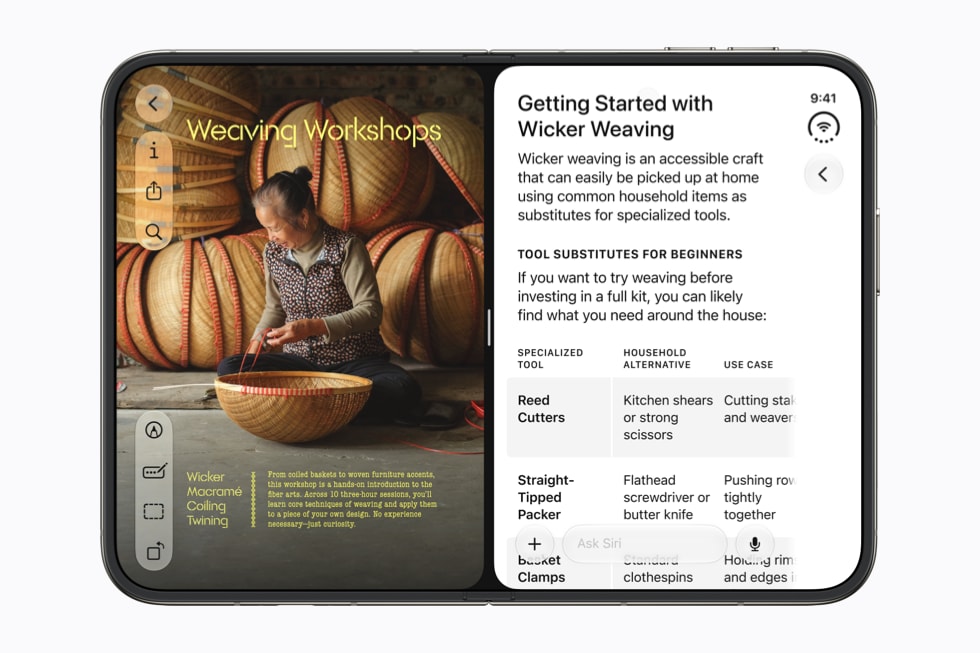
The foldable also introduces Apple Pencil support — a first for any iPhone — although it will work only with the USB-C Apple Pencil and arrives in a software update later in the year. Siri AI, the rebuilt version of Apple's assistant rolling out with iOS 27, is tuned for the larger screen, letting users hold a conversation on one side of the display while referencing content on the other.
Price, Release Date, and What's Next
The iPhone Duo starts at $1,999 for the 256GB model, with storage options extending up to 2TB. Pre-orders begin October 16, 2026, with availability starting October 23 in about 70 countries and regions; an additional 28 countries and regions follow on October 30. New accessories include the iPhone Duo Folio case with a built-in kickstand and a two-part case that wraps around each half of the device, both compatible with MagSafe and Qi2 wireless charging.
Looking ahead, the biggest question is demand. Apple has reportedly ordered 10 million units, and some analysts expect the foldable to reinvigorate a smartphone market that has seen years of incremental upgrades. Early resale-value analyses have been cautious, with one study from SellCell suggesting the device could lose more than $1,000 of its value in its first year. For now, the iPhone Duo's success will hinge on whether buyers are willing to pay a premium for a foldable form factor that Apple has spent 15 years refining.
Key Takeaways
- The iPhone Duo is Apple's first foldable smartphone, announced September 9, 2026.
- It features a 5.4-inch outer display and a 7.6-inch inner display in a book-style, titanium design.
- Powered by the 2nm A20 Pro chip with 12GB of RAM, dual 48MP Fusion cameras, and a dual-battery system.
- Pricing starts at $1,999, with pre-orders October 16 and release October 23, 2026.
- It ships with iOS 27.1 and is the first iPhone to support the Apple Pencil.