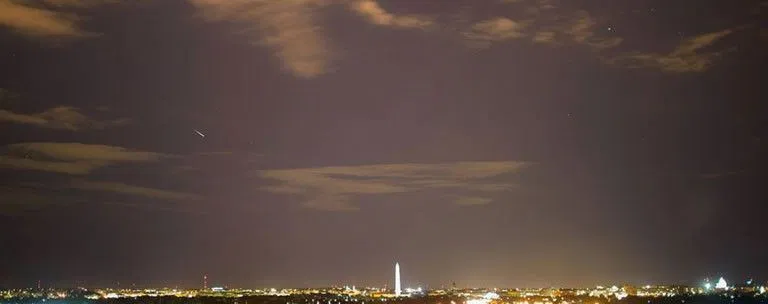
On the nights around August 12, skywatchers across the Northern Hemisphere turn their eyes skyward for one of the year's most dependable celestial shows: the Perseid meteor shower. NASA describes the Perseids as "the best meteor shower of the year," and the numbers back that up. At its peak, under a dark, moonless sky, the shower can deliver 90 or more meteors per hour — many of them bright, colorful, and leaving glowing trails behind them. In 2026, the timing is unusually kind to observers, because a new moon falls right at the peak, which means darker skies and a better show. Here's what causes the Perseids, exactly when to watch, and how to maximize your chances of catching shooting stars.
What Is a Meteor Shower — and Why Do the Perseids Happen Every August?
A meteor shower occurs when Earth plows through a stream of debris left behind by a comet. As a comet swings around the Sun, it sheds tiny bits of dust, ice, and rock. Over time, this material spreads out along the comet's orbit, forming what astronomers call a meteor stream. When our planet crosses one of these streams, the particles slam into Earth's atmosphere and burn up, producing the bright streaks we call meteors — or, more casually, shooting stars.
The Perseids are produced by a fairly large comet called 109P/Swift-Tuttle, which orbits the Sun roughly every 133 years. Each August, Earth passes through the debris this comet has left behind, and the result is a shower of meteors that lasts from about July 14 through September 1. The particles themselves are tiny — most are no bigger than a grain of sand — but they enter the atmosphere at extreme speeds and disintegrate about 60 miles (100 kilometers) above the ground, creating a flash of light visible from far below.
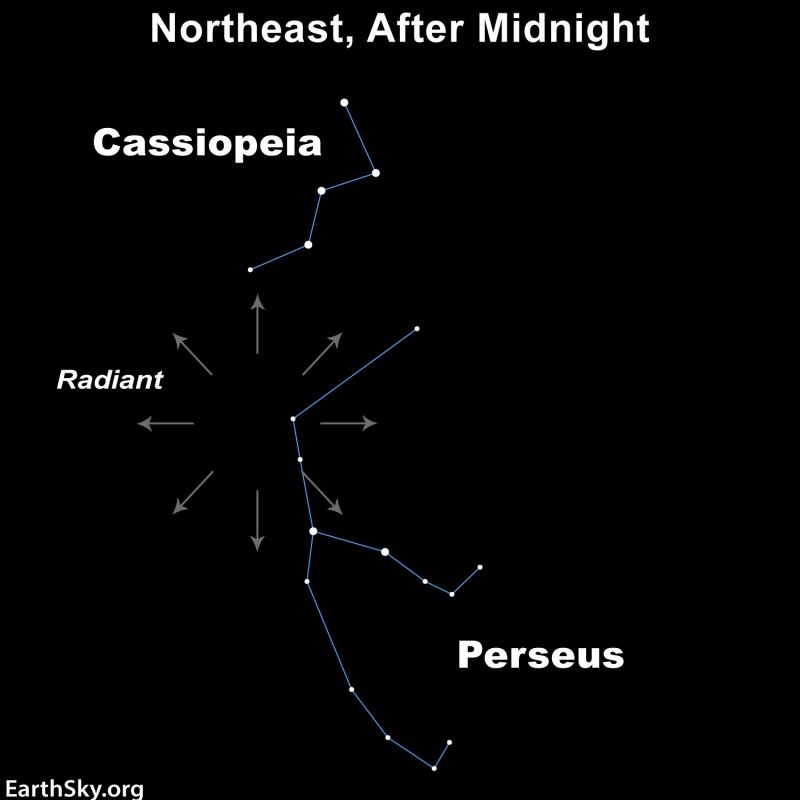
The shower gets its name from its radiant, the point in the sky from which the meteors appear to originate. If you trace a Perseid meteor's path backward, it seems to come from the constellation Perseus the Hero. The stars of Perseus are many light-years away, while the meteors burn up just tens of miles above Earth's surface — the connection is purely a trick of perspective.
When Does the Perseid Meteor Shower Peak in 2026?
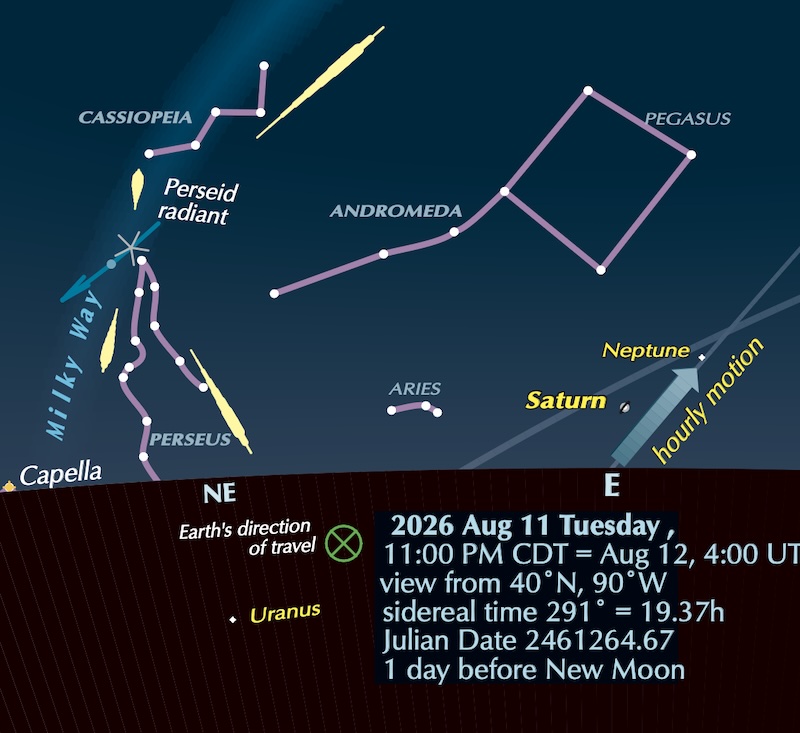
According to the American Meteor Society, the 2026 Perseid peak is predicted for 14:53 UTC on August 13. For most viewers in the Northern Hemisphere, that means the mornings of August 12 and 13 are the best times to watch, with the mornings of August 11 and 14 also worth checking. The Perseids tend to build toward their peak gradually and then fall off quickly afterward, so aim for the nights right around the peak.
The 2026 peak is especially well timed. A new moon falls at 17:37 UTC on August 12, meaning there will be no moonlight to wash out fainter meteors during the key viewing mornings. There's even a cosmic bonus this year: a total solar eclipse will darken skies over parts of the Arctic, Greenland, Iceland, and Spain on August 12. A few lucky eclipse watchers could conceivably catch a Perseid streaking across the darkened daytime sky during totality.
How to Watch the Perseid Meteor Shower
You don't need any special equipment to enjoy the Perseids — binoculars and telescopes actually narrow your field of view and make it harder to catch fast-moving meteors. The key is timing and location.
Watch in the hours before dawn. The radiant in Perseus rises in the late evening and climbs higher through the night, reaching its highest point just before dawn. That's why the best Perseid viewing happens after midnight and into the pre-dawn hours. Avoid watching in the early evening, when the radiant is still low on the horizon and far fewer meteors are visible.
Find a dark sky. Get as far from city lights as you can. Light pollution is the single biggest enemy of meteor watching. A dark location — a park, a rural area, or even a backyard with the lights off — can make a dramatic difference in how many meteors you see.
Give your eyes time to adjust. It takes roughly 20 to 30 minutes for your eyes to fully adapt to the dark. Put your phone away, avoid bright screens, and use a red-light flashlight if you need to check something.
Lie back and take in the whole sky. You don't need to stare at the radiant. Perseids can appear anywhere in the sky, so a reclining chair or a blanket on the ground gives you the widest view. Patience pays off — meteor rates can come in bursts, so give yourself at least an hour of observing time.
One caveat: the Perseids favor the Northern Hemisphere. From many populated areas in the Southern Hemisphere (roughly south of 30 degrees south latitude), the radiant never rises above the horizon, so the Perseids aren't a major shower there.
Why the Perseids Stand Out: Fireballs, Colors, and Glowing Trains
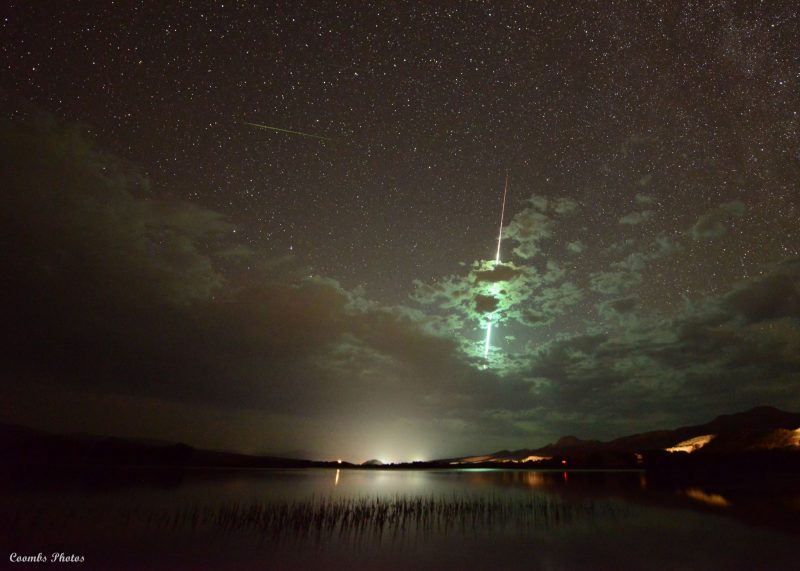
Plenty of meteor showers occur throughout the year, but the Perseids have a reputation for being the richest and most crowd-pleasing. Under ideal dark-sky conditions, observers frequently report 90 or more meteors per hour at the peak. The shower is steady and reliable, and its meteors are often vivid — frequently bright and colorful.
The Perseids are also known for producing fireballs, which are exceptionally bright meteors that can rival the planet Venus in brightness. Many Perseids leave persistent trains, glowing streaks of ionized gas that can linger in the sky for a second or two after the meteor itself has faded. Combined with warm August nights across much of the Northern Hemisphere, these qualities make the Perseids a favorite for casual stargazers and astrophotographers alike.
A Brief History of Comet Swift-Tuttle and the Perseids
The story behind the Perseids stretches back to the discovery of their parent comet. American astronomer Lewis Swift spotted comet 109P/Swift-Tuttle on July 16, 1862, using a small refractor telescope. He initially thought he was observing a different comet, so he delayed reporting it — and three days later, astronomer Horace Tuttle independently picked it up from Harvard Observatory. The comet was later named for both men.
Early calculations suggested the comet would return in about 120 years, around 1982 — but it didn't show up. Astronomers went back to work, identified an earlier sighting of the comet from 1737, and revised the orbital period to roughly 133 years. Their updated prediction proved correct: on September 26, 1992, Japanese amateur astronomer Tsuruhiko Kiuchi rediscovered the comet in the evening sky. Researchers have since linked the comet to observations dating as far back as 69 BCE and 188 CE.
The shower also carries a mythological thread. In ancient Greek lore, Perseus was the son of the god Zeus and the mortal Danaë. The Perseid shower was said to commemorate the moment Zeus visited Danaë in a shower of gold — an apt image for a sky full of bright, fleeting streaks.
The Bottom Line: Key Points to Remember
- The Perseid meteor shower peaks around August 12–13, 2026, with the predicted maximum at 14:53 UTC on August 13.
- Best viewing is after midnight and before dawn on the mornings of August 12 and 13.
- A new moon on August 12 means moon-free, darker skies for the peak.
- The shower comes from debris shed by comet 109P/Swift-Tuttle, which orbits the Sun about every 133 years.
- Under a dark sky, the Perseids can produce 90 or more meteors per hour, including bright fireballs and colorful meteors with persistent trains.
- No equipment is needed — just a dark location, patience, and a wide view of the sky.