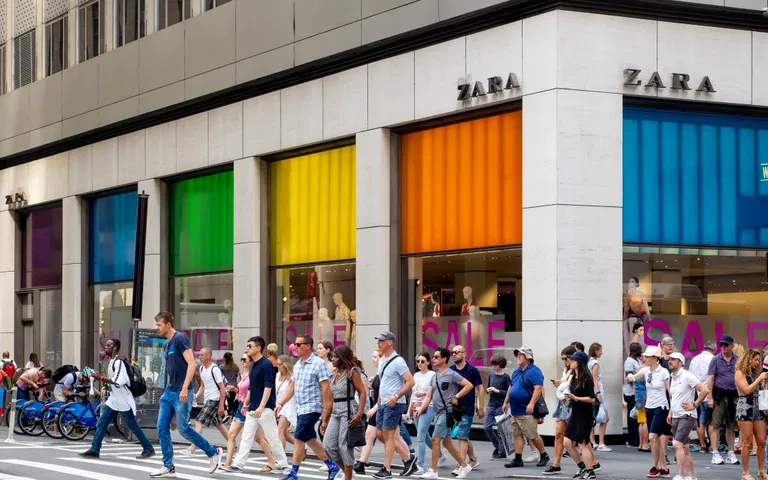
Zara is the flagship brand of Inditex, the Spanish retail group that changed global fashion by proving a new design can travel from a designer's sketch to a store shelf in about two weeks. Founded in 1975 by Amancio Ortega and Rosalía Mera in the Galician city of A Coruña, Zara grew from a single family-run shop into one of the most recognized clothing chains in the world, with nearly 3,000 stores across 96 countries and sales that account for roughly 70% of Inditex's group revenue. But what makes Zara genuinely remarkable is not its size — it is the operating system behind it. While traditional retailers plan collections months in advance and gamble on forecasts, Zara built a model around speed, data and vertical integration. That system, now known as fast fashion, is studied in business schools worldwide and explains exactly how Zara works.
Inside Zara's Two-Week Design-to-Store Machine
The heart of Zara's model is a continuous feedback loop that starts on the sales floor. Store managers and staff report daily on what customers are buying, what they are asking for, and what is not selling. This information is transmitted to Zara's sales and design teams at the Inditex headquarters complex in Arteixo, Galicia — a sprawling facility known as "The Cube" — where a team of roughly 300 designers creates new items in response. Analysts describe this as customer co-creation rather than traditional trend forecasting, because Zara reacts to real demand instead of predicting it a year in advance.
From there, Zara relies on what supply-chain researchers call selective vertical integration: the company tightly coordinates design, production, distribution and retail under one roof. Unlike rivals that outsource most manufacturing to Asia with lead times of up to six months, Zara keeps a large share of production close to home — in Spain, Portugal and North Africa — so it can react quickly. The result is a design-to-store cycle of roughly two weeks, compared with a seasonal cycle of several months for the rest of the industry.
Speed is reinforced by how Zara manages inventory. Instead of producing huge runs of each item, Zara makes small batches, ships them through centralized logistics hubs in Spain, and uses RFID tags across every store to track stock in real time. When an item sells out, the company knows immediately and can decide whether to replenish or move on. This approach helps Zara turn over its inventory around 12 times a year, against an industry average of three to four times, and it cuts the markdowns that eat into competitors' margins. Zara introduces roughly 11,000 distinct designs each year, while most rivals refresh their ranges far less often.
From One Shop in Spain to 96 Countries
Zara's history is a story of steady, deliberate expansion. In 1975, Amancio Ortega — who began his career as a delivery and shop assistant for a local shirtmaker — opened the first Zara store in A Coruña with his then-wife Rosalía Mera. A decade later, in 1985, Ortega formalized the business by founding Inditex (Industria de Diseño Textil) as the holding company in nearby Arteixo. Zara crossed Spain's borders in 1988 with a store in Porto, Portugal, followed by its first United States store on Lexington Avenue in New York in 1989 and a Paris flagship in 1990. The group went public on the Madrid Stock Exchange in 2001, and today its parent Inditex runs eight brands — Zara, Pull&Bear, Massimo Dutti, Bershka, Stradivarius, Oysho, Zara Home and Lefties — across more than 90 markets, with Zara alone now reaching 96 countries.

Why Zara's Model Changed Fashion Forever
Before fast fashion, the industry operated on a seasonal calendar: designers would predict trends up to a year ahead, order large volumes, and hope their guesses paid off. Zara inverted that logic. Rather than predict demand, it observes demand in near real time and produces only what customers appear to want. Because it ships small, frequently refreshed quantities, Zara creates a sense of scarcity that encourages shoppers to buy immediately — an item might be gone by their next visit — and it sells a higher share of garments at full price. This combination of speed, data and scarcity has made Zara the benchmark that competitors from H&M to ultra-fast online rivals such as Shein have been forced to imitate.
That influence has also made Zara a focal point of the fast-fashion debate. Critics point to the environmental cost of rapid production cycles, overproduction and air freight, arguing that the model encourages short-lived trends and disposable clothing. Independent reviews have been harsh: one sustainability brand rating scored Zara just 3 out of 100 in 2024, citing concerns over transparency, workers and materials. In response, Inditex has set public targets — including a 2019 pledge for all Zara garments to be sustainable by 2025 — and reports that 88% of the fibres used in its collections are now organic, recycled or other lower-impact alternatives.
Where Zara Stands Today
Zara remains the engine of the Inditex group. In its most recent full-year results, Inditex reported group sales of around €39.9 billion, with Zara contributing about €28 billion of that total. The company kept opening stores in new markets — 41 of them in 2025 — while also optimizing its network toward fewer, larger flagship locations. On the technology side, Zara and its parent have pushed deeper into automation, using RFID across all stores, an integrated stock-management system, and AI and machine learning to forecast demand and automate replenishment. E-commerce now runs alongside the physical network as a core channel rather than an afterthought, and founder Amancio Ortega remains one of the world's wealthiest people, with Forbes estimating his fortune at roughly $79.5 billion.
What's Next for Zara
Looking ahead, Zara's strategy is shaped by two forces pulling in opposite directions. On one side, the company is investing in data, AI and logistics to make its already fast supply chain even faster and more precise. On the other, growing regulatory and consumer pressure on fast fashion is pushing it toward sustainability commitments, circularity and lower-impact materials. Analysts expect Zara to keep consolidating into larger, more experiential stores while expanding online, and to face intensifying competition from ultra-cheap digital rivals. The central challenge will be whether the model that made Zara famous — constant newness at high speed — can coexist with the slower, more responsible fashion its critics demand.
The Bottom Line: How Zara Works in 7 Points
- Zara is the flagship brand of Inditex, founded in Spain in 1975 by Amancio Ortega and Rosalía Mera.
- It moves new designs from sketch to store in about two weeks, versus a six-month seasonal cycle for many rivals.
- Store staff feed daily customer feedback to a 300-person design team, so Zara reacts to demand rather than guessing trends.
- Vertical integration and nearby production in Spain, Portugal and North Africa keep the supply chain fast and flexible.
- Small batches, RFID tracking and frequent refreshes create scarcity and turn inventory about 12 times a year.
- Zara reaches nearly 3,000 stores in 96 countries and drives about 70% of Inditex's revenue.
- The same speed that built the empire is now at the center of the fast-fashion sustainability debate.