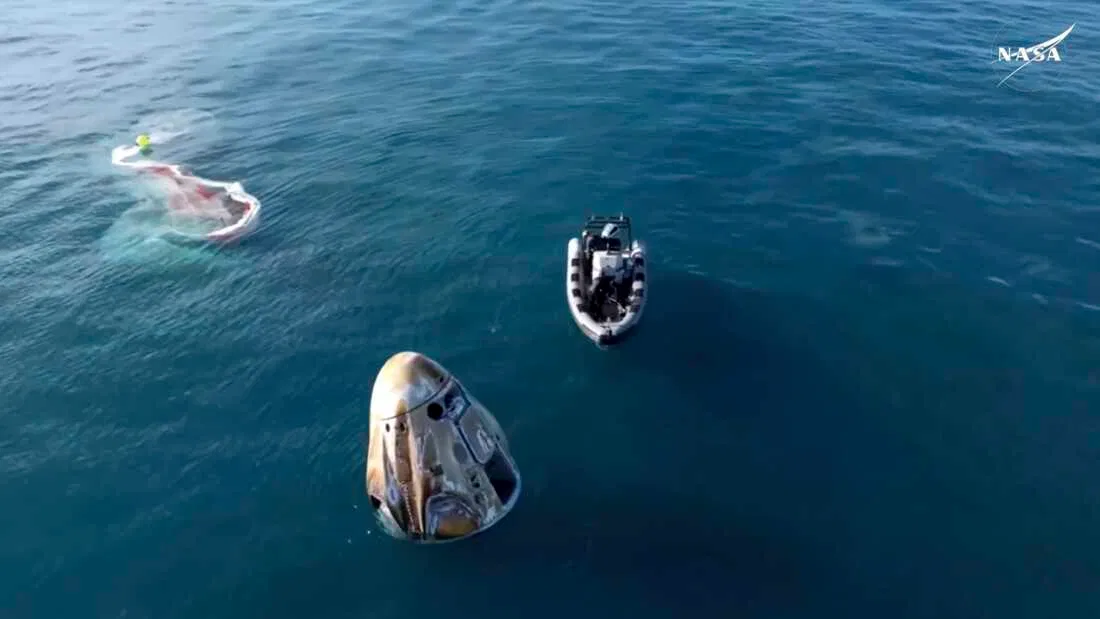
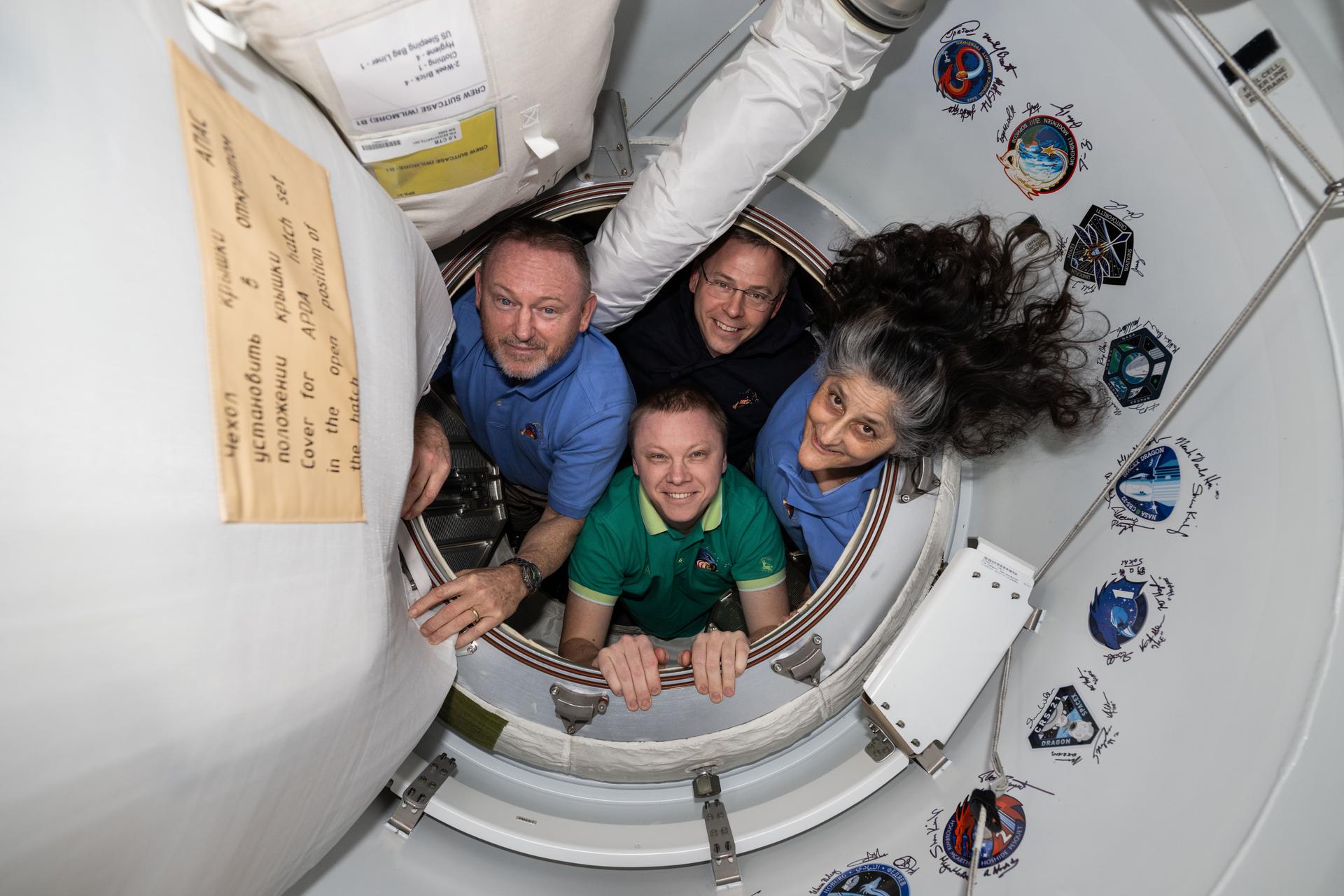
When NASA astronauts Suni Williams and Butch Wilmore finally returned to Earth on March 18, 2025, their homecoming marked the end of a space odyssey that had stretched far beyond expectations. What began as a planned 8-day test flight of Boeing's new Starliner spacecraft transformed into a 286-day mission aboard the International Space Station, culminating in a dramatic return via SpaceX Dragon capsule. Their journey home—a carefully orchestrated sequence of undocking, re-entry, and splashdown—demonstrates the complex physics and precise engineering required to bring astronauts safely back from space.
How a Planned 8-Day Mission Turned Into a 9-Month Space Odyssey
The story of Williams and Wilmore's extended stay in space began on June 5, 2024, when they launched aboard Boeing's CST-100 Starliner spacecraft for what was supposed to be a brief test mission. As the first crewed flight of Boeing's new capsule, the mission aimed to certify Starliner for regular astronaut transport to the International Space Station. However, shortly after reaching orbit, the spacecraft experienced multiple helium leaks and thruster malfunctions that raised safety concerns.
NASA faced a critical decision: return the astronauts on a potentially compromised vehicle or find an alternative solution. Choosing caution, the agency decided to send Starliner back to Earth without crew while integrating Williams and Wilmore into the space station's regular crew rotation. This decision turned their week-long test flight into a 9-month stay, during which they conducted scientific experiments, performed spacewalks, and waited for their replacement crew to arrive.
The Physics of Coming Home: Understanding Spacecraft Re-entry
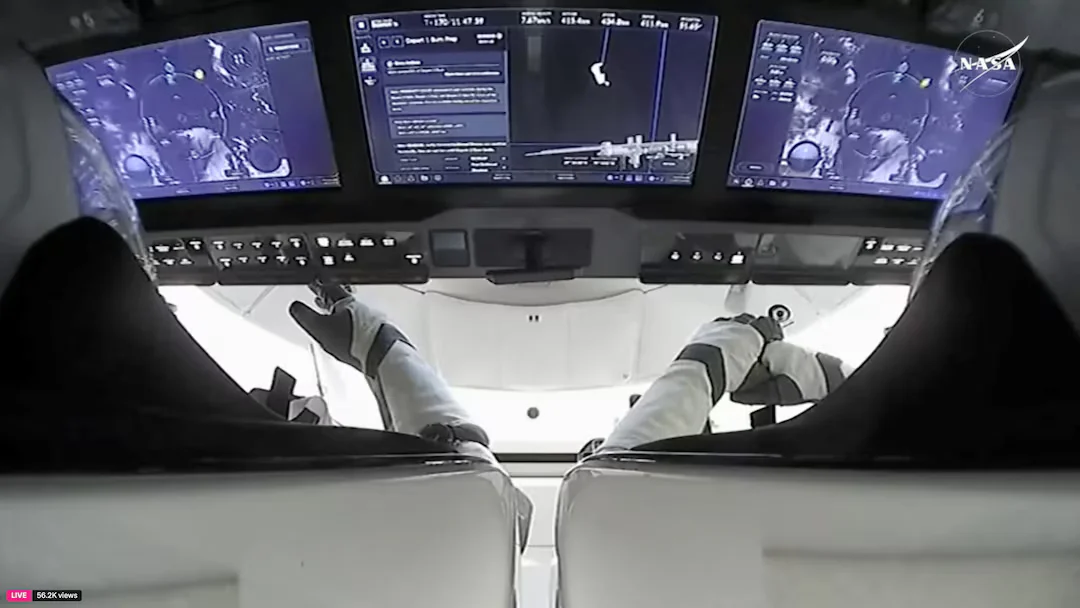
Returning from space presents one of the most challenging engineering problems in spaceflight. When Williams, Wilmore, and their crewmates began their journey home, their Dragon capsule was orbiting Earth at approximately 17,000 miles per hour (27,359 kilometers per hour). To return safely, they needed to slow down dramatically—but doing so creates intense heat that can reach 3,000°F (1,649°C).
The re-entry process relies on several key physical principles. First, the capsule performs a deorbit burn, firing its thrusters to slow down just enough to begin descending into Earth's atmosphere. As it enters the atmosphere, the spacecraft encounters increasing air resistance. This friction creates the fiery plasma visible during re-entry, but also generates tremendous heat that must be managed carefully.
Modern spacecraft like SpaceX's Dragon use blunt-body designs and advanced heat shields to manage this thermal challenge. The capsule's rounded shape creates a shock wave that pushes most of the heat away from the vehicle, while the heat shield—made of phenolic impregnated carbon ablator (PICA-X) material—gradually burns away, carrying heat with it. This combination allows the spacecraft to survive temperatures that would melt most metals.
Timeline: From Launch to Splashdown in 286 Days
The journey of Williams and Wilmore represents one of the most dramatic timeline shifts in recent spaceflight history. Here's how their mission unfolded:
- June 5, 2024: Launch aboard Boeing Starliner from Cape Canaveral, Florida for planned 8-day mission
- June 6, 2024: Docking with International Space Station, but discovery of multiple helium leaks and thruster issues
- September 2024: NASA decides to return Starliner without crew, leaving Williams and Wilmore on ISS
- March 16, 2025: Replacement Crew-10 arrives at space station, allowing Williams and Wilmore to prepare for return
- March 18, 1:05 a.m. EDT: SpaceX Dragon undocks from International Space Station
- March 18, 5:57 p.m. EDT: Dragon splashes down in Gulf of Mexico off Florida coast
- March 18, evening: Astronauts flown to NASA's Johnson Space Center for medical evaluation
The total mission duration of 286 days far exceeded the planned 8 days, though it remained shorter than the U.S. record of 371 days set by astronaut Frank Rubio in 2023. For Suni Williams, this mission brought her cumulative time in space to 608 days—the second most of any U.S. astronaut, trailing only Peggy Whitson's 675 days.
What Happens After Splashdown: Astronaut Recovery and Health Checks
The moment the Dragon capsule splashed down marked the beginning of a critical recovery process. Within minutes, recovery teams in boats reached the spacecraft to secure it and begin extracting the astronauts. This immediate response is crucial because extended periods in space cause significant physiological changes that must be carefully managed.
"What a ride," NASA astronaut Nick Hague, the Crew-9 mission commander, told mission control moments after splashing down. "I see a capsule full of grins, ear to ear." Despite the smiles, all returning astronauts face immediate challenges readjusting to Earth's gravity after months in microgravity.
NASA flight surgeons conduct initial medical checks at the splashdown site before flying the crew to Johnson Space Center in Houston. There, they undergo several days of comprehensive medical evaluation, monitoring how their bodies readjust to gravity. Common issues include muscle atrophy, bone density loss, balance problems, and potential vision changes—all consequences of prolonged exposure to microgravity.
As NASA astronaut Michael Barratt explained after a previous mission, "Spaceflight is still something we don't fully understand. We're finding things that we don't expect sometimes." This uncertainty makes post-mission medical monitoring essential for both astronaut health and advancing our understanding of long-duration spaceflight.
What's Next for Boeing's Starliner and Future Space Missions
The extended mission of Williams and Wilmore has significant implications for NASA's commercial crew program and future space operations. Boeing's Starliner, intended to provide NASA with a second option for crew transport alongside SpaceX's Dragon, now faces an uncertain future following the technical issues that stranded its first crew.
According to NASA's Commercial Crew Program chief Steve Stich, Starliner may need to fly another uncrewed test mission—which would be its third such flight—before it can be certified for routine astronaut transport. This represents a significant setback for Boeing, which had hoped to establish Starliner as a reliable competitor to SpaceX's proven Dragon spacecraft.
Meanwhile, the political dimensions of the mission continue to resonate. The extended stay became a talking point during the presidential transition, with President Trump calling for an earlier return and Elon Musk offering SpaceX resources to bring the astronauts home sooner. NASA maintained that operational requirements, not politics, dictated the timeline, noting that maintaining adequate crew levels on the space station was essential for safety and research continuity.
Key Takeaways: What We Learned From This Extended Mission
The 286-day mission of Williams and Wilmore provides several important lessons for the future of human spaceflight:
- Redundancy is essential: Having multiple spacecraft options (SpaceX Dragon and eventually Boeing Starliner) allowed NASA to adapt when one vehicle experienced problems
- Contingency planning works: As Butch Wilmore noted, "We came prepared to stay long, even though we planned to stay short. That's what your nation's human spaceflight program's all about—planning for unknown, unexpected contingencies."
- International cooperation remains vital: The smooth integration of Williams and Wilmore into the ISS crew rotation demonstrates the value of international partnership in space
- Science continues during unexpected events: Despite the extended stay, the astronauts conducted approximately 150 scientific experiments, contributing valuable data for future missions
- Public engagement matters: The mission captured global attention, reminding people of both the challenges and triumphs of human space exploration
As commercial spaceflight continues to evolve and NASA prepares for missions to the Moon and eventually Mars, the lessons learned from this extended mission will inform future contingency planning and crew safety protocols. The successful return of Williams and Wilmore—despite the unexpected challenges—demonstrates both the resilience of the astronauts and the robustness of NASA's systems for keeping humans safe in the harsh environment of space.