The U.S. Food and Drug Administration (FDA) has elevated a sweeping egg recall to Class I — its highest risk level — after a Salmonella outbreak linked to the eggs sickened 98 people and sent 26 to the hospital across 17 states. The recall covers more than 19 million white and brown cage-free shell eggs produced by Midwest Poultry Services, L.P. at two farms in Texas, and sold under brand names including Kroger, Simple Truth, Brookshire's, Country Morning, and Sunups. If you recently bought eggs in Texas, Louisiana, Oklahoma, or a neighboring state, here's exactly how to check your carton — and why the "Class I" designation matters for your household's safety.
What Does a Class I Recall Actually Mean?
Every recall the FDA monitors is assigned a classification that signals how dangerous the product could be. A Class I recall is the most serious tier. The agency defines it as "a situation in which there is a reasonable probability that the use of or exposure to a violative product will cause serious adverse health consequences or death."
By comparison, a Class II recall involves products that might cause temporary or medically reversible health problems, while a Class III recall covers products unlikely to cause harm but that still violate regulations. When regulators move a recall up to Class I, it's a strong signal that the contaminated food poses a genuine threat — which is why consumers are told not to eat the affected eggs at all, even though they may look and smell perfectly normal.
In this case, Midwest Poultry Services voluntarily recalled the eggs on July 22, 2026, after its own "proactive environmental monitoring practices and root cause analysis" flagged potential Salmonella Enteritidis contamination. The FDA then raised the recall to Class I on August 12, 2026, as illnesses mounted across the country.
How to Check If the Eggs in Your Fridge Are Recalled
The recalled eggs were produced at two Midwest Poultry Services farms in Texas between June 6 and July 3, 2026, and carry sell-by or best-by dates from July 20 through August 17, 2026. They were shipped to foodservice and retail customers in Texas, Oklahoma, and Louisiana, including Kroger stores in Texas and Louisiana and Brookshire Grocery stores in Texas, Oklahoma, Arkansas, Louisiana, New Mexico, and Mississippi.
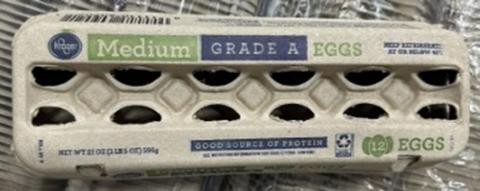
Here's how to identify a recalled carton. Look at the left or right side of the carton for a plant code printed in date-coding ink. Only cartons with the code P-1950 or 0840962 — paired with a Julian date (the day of the year the eggs were packed) between 157 and 184 — are affected. Affected brands and products include:
- Kroger: Large (12, 18, and 60 count), Extra Large 12, Medium (12 and 30 count), and Jumbo 12 eggs
- Simple Truth Cage Free: Medium and Large (12, 18, and 24 count) brown eggs
- Brookshire's: Large (6, 12, 18, 36, and 60 count), Extra Large 18, and Jumbo 12 eggs
- Country Morning: Large (12, 18, and 2½ dozen), Extra Large 12, Medium 12, and Jumbo 12 eggs
- Sunups: Medium 2½ dozen
Several bulk Grade A and Grade AA products — ranging from 15 to 30 dozen — are also included in the recall. No other Midwest Poultry Services products are affected.
Timeline: From Texas Farms to a 17-State Outbreak
Here's how the recall and the outbreak unfolded:
- June 6 – July 3, 2026: The recalled eggs are produced and distributed from two Texas farms.
- July 22, 2026: Midwest Poultry Services announces a voluntary recall of 1,589,577 dozen eggs due to possible Salmonella Enteritidis contamination.
- July 24, 2026: The FDA publishes its outbreak investigation, linking illnesses to the recalled eggs.
- August 12, 2026: The FDA upgrades the recall to Class I, its highest severity level.
According to the Centers for Disease Control and Prevention (CDC), 98 people across 17 states have been sickened in the outbreak, with 26 hospitalizations and no reported deaths. The FDA reports that illnesses in the outbreak were recorded as early as November 21, 2025 and as recently as June 30, 2026. The agency notes the recalled eggs are a "likely source" of many of the illnesses, but the producer "does not account for all the illnesses," so the investigation remains ongoing. Texas has reported the most cases, with 73 of the 98.
Salmonella Symptoms to Watch For — and When to Call a Doctor
Salmonella is a type of bacteria that can cause a gastrointestinal infection known as salmonellosis. Most people who are infected develop diarrhea, fever, and stomach cramps, with symptoms typically starting between six hours and six days after swallowing the bacteria. Many recover on their own within four to seven days.
Some groups face a higher risk of severe illness: children younger than 5, adults 65 and older, and people with weakened immune systems. The CDC recommends contacting a health care provider right away if you experience any of the following:
- Diarrhea and a fever higher than 102°F
- Diarrhea for more than two days that is not improving
- Bloody diarrhea
- Vomiting so much that you cannot keep liquids down
- Signs of dehydration, such as urinating less than usual, dry mouth and throat, or feeling dizzy when standing up
How to Prevent Salmonella in Your Own Kitchen
Even beyond this recall, Salmonella is a leading cause of foodborne illness, and eggs are one of its most common vehicles. The CDC's four core food-safety steps can dramatically reduce your risk:
- Clean: Wash your hands, utensils, and surfaces often, and rinse produce under running water.
- Separate: Keep foods that won't be cooked away from raw meat, poultry, seafood, and eggs.
- Cook: Use a food thermometer and cook foods to a temperature high enough to kill germs — cook eggs until both the yolk and white are firm, and cook egg dishes to an internal temperature of 160°F.
- Chill: Refrigerate perishable foods, including eggs, within two hours (or within one hour if it's hotter than 90°F outside), and keep eggs stored at 40°F or below.
Salmonella can be present on both the outside and inside of eggs, so it's important to buy refrigerated eggs, discard cracked or visibly dirty eggs, and wash anything that touches raw eggs with hot, soapy water.
What to Do If You Have Recalled Eggs
If your carton matches the recalled codes and date ranges, do not eat the eggs. Return them to the store where you bought them for a full refund, or throw them away. Midwest Poultry Services has stopped distributing fresh eggs from its Texas farms while the investigation continues. Consumers with questions can call the company at 574-405-9531 (Monday through Friday, 8 a.m. to 4:30 p.m. ET) or email [email protected].
The Bottom Line: Key Takeaways
- The FDA upgraded a recall of more than 19 million eggs to Class I, its highest risk level, on August 12, 2026.
- The recalled eggs came from Midwest Poultry Services' Texas farms and were sold under Kroger, Simple Truth, Brookshire's, Country Morning, and Sunups brands.
- Check for plant codes P-1950 or 0840962 with a Julian date between 157 and 184 and sell-by dates from July 20 to August 17, 2026.
- The linked Salmonella outbreak has sickened 98 people and hospitalized 26 across 17 states.
- If you have recalled eggs, return them for a refund and watch for Salmonella symptoms such as diarrhea, fever, and stomach cramps.